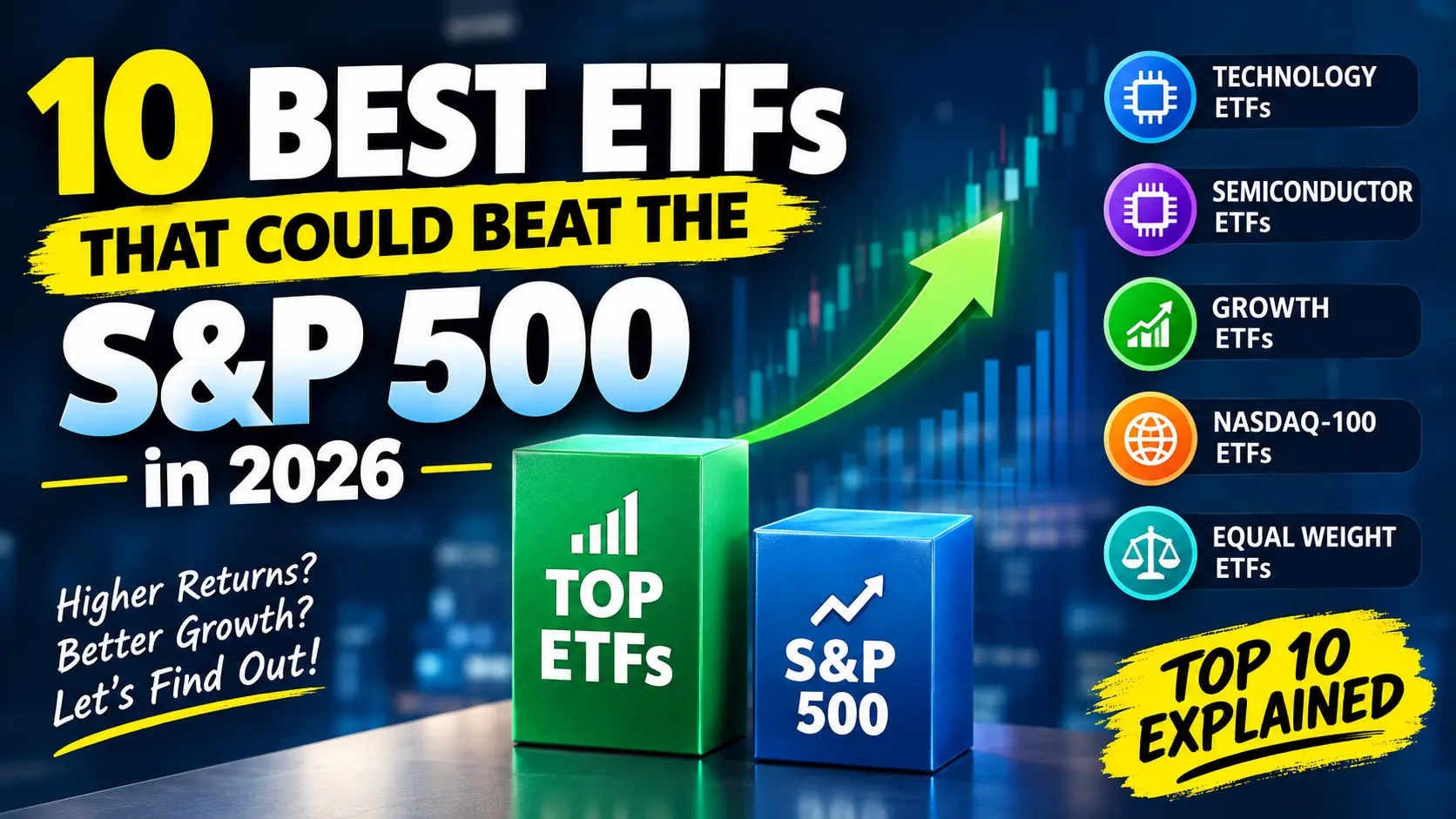
10 Best ETFs: Investors looking for long-term wealth creation often search for ETFs that can outperform the S&P 500. The S&P 500 is widely used as a benchmark for the U.S. stock market because it tracks approximately 500 leading companies across multiple industries.
However, some exchange-traded funds focus on specific sectors, investment styles, or market segments that have delivered stronger returns than the S&P 500 during certain periods.
Technology, semiconductor, and large-cap growth ETFs have attracted considerable attention because of their exposure to artificial intelligence, cloud computing, digital services, and other expanding industries.
But which ETFs deserve attention in 2026?
In this guide, we explore 10 ETFs with historical outperformance potential, their investment strategies, advantages, risks, and factors to consider before investing.
Important: Historical performance does not guarantee future returns. An ETF that outperformed the S&P 500 in the past may underperform it in the future.
What Is the S&P 500?
The S&P 500 is a stock market index that tracks approximately 500 large publicly traded companies in the United States.
It includes businesses from sectors such as:
- Technology
- Healthcare
- Financial services
- Consumer goods
- Communication services
- Industrials
- Energy
Many investors use the S&P 500 as a benchmark for evaluating investment performance.
Popular ETFs that track this index include:
| ETF | Fund Name | Expense Ratio |
|---|---|---|
| VOO | Vanguard S&P 500 ETF | Approximately 0.03% |
| SPY | SPDR S&P 500 ETF Trust | Approximately 0.0945% |
| IVV | iShares Core S&P 500 ETF | Approximately 0.03% |
The S&P 500 offers broad diversification, but investors seeking higher growth sometimes explore more concentrated ETFs.
Top 10 ETFs to Research for Potential S&P 500 Outperformance
The following ETFs are organized by investment theme, not by a verified prediction of future returns.
1. VanEck Semiconductor ETF (SMH)
Ticker: SMH
Investment Focus: Semiconductor companies
Category: Sector ETF
The VanEck Semiconductor ETF provides exposure to companies involved in semiconductor production and related technologies.
Semiconductors are essential components in:
- Artificial intelligence systems
- Smartphones
- Data centers
- Electric vehicles
- Gaming hardware
- Cloud computing infrastructure
SMH has attracted investor interest because of the growing demand for advanced chips and AI-related infrastructure.
Why investors research SMH
- Exposure to the semiconductor industry
- Potential benefit from AI infrastructure growth
- Access to major chip manufacturers and equipment companies
- Historical periods of strong performance
Risks
The semiconductor industry is cyclical. Demand can change quickly, and the ETF may experience significant volatility.
Best suited for: Investors who understand sector concentration and are comfortable with higher risk.
2. iShares Semiconductor ETF (SOXX)
Ticker: SOXX
Investment Focus: U.S. semiconductor companies
Category: Sector ETF
The iShares Semiconductor ETF invests in companies involved in the semiconductor industry.
It offers exposure to businesses that manufacture chips, design processors, and provide semiconductor-related equipment.
Why consider SOXX?
- Exposure to semiconductor innovation
- Participation in the development of AI hardware
- Access to established semiconductor businesses
- Potential long-term growth opportunities
SOXX and SMH have overlapping holdings, so investors should compare their portfolios before buying both.
Risks
Semiconductor stocks can be affected by:
- Economic slowdowns
- Supply-chain disruptions
- Export restrictions
- Competition
- High valuations
Best suited for: Investors seeking targeted exposure to semiconductor companies.
3. Vanguard Information Technology ETF (VGT)
Ticker: VGT
Investment Focus: U.S. information technology companies
Category: Technology ETF
VGT provides exposure to a broad range of U.S. technology companies.
Its holdings may include businesses involved in:
- Software
- Hardware
- Information technology services
- Semiconductor equipment
- Data processing
Why investors consider VGT
Technology companies have played an important role in the growth of the U.S. stock market.
VGT offers exposure to the technology sector through a diversified group of companies rather than focusing exclusively on one industry.
Benefits
- Broad technology-sector exposure
- Generally low expense ratio
- Exposure to established and emerging technology businesses
- Long-term growth potential
Risks
Technology stocks can be sensitive to interest rates, economic conditions, and changing investor expectations.
Best suited for: Long-term investors seeking technology-sector exposure.
4. Technology Select Sector SPDR Fund (XLK)
Ticker: XLK
Investment Focus: Technology companies within the S&P 500
Category: Sector ETF
XLK tracks the technology sector of the S&P 500.
The fund provides exposure to large technology businesses involved in areas such as:
- Software
- Hardware
- Semiconductors
- Technology services
Why research XLK?
XLK allows investors to focus on the technology sector without purchasing individual technology stocks.
Technology companies have benefited from trends such as digital transformation, cloud computing, and artificial intelligence.
Advantages
- Exposure to major U.S. technology companies
- Easy access through a widely traded ETF
- Potential for long-term capital appreciation
Risks
XLK is less diversified than a broad-market S&P 500 ETF and may experience larger declines during technology-sector sell-offs.
Best suited for: Investors who want targeted exposure to large U.S. technology companies.
5. Invesco QQQ Trust (QQQ)
Ticker: QQQ
Investment Focus: Nasdaq-100 companies
Category: Large-cap growth-oriented ETF
The Invesco QQQ Trust tracks the Nasdaq-100 Index, which includes 100 of the largest nonfinancial companies listed on the Nasdaq Stock Market.
Its holdings include companies from industries such as:
- Technology
- Communication services
- Consumer discretionary
- Healthcare
Why QQQ attracts investors
QQQ provides exposure to many influential growth companies in the U.S. market.
Its performance is strongly influenced by large companies in technology and related industries.
Potential benefits
- Exposure to major growth companies
- Access to innovative businesses
- Long-term growth opportunities
- Broad exposure across several nonfinancial industries
Risks
QQQ can be highly sensitive to:
- Interest-rate changes
- Technology-sector valuations
- Mega-cap stock performance
- Market sentiment
Best suited for: Investors seeking exposure to large-cap growth companies.
6. iShares U.S. Technology ETF (IYW)
Ticker: IYW
Investment Focus: U.S. technology companies
Category: Technology ETF
IYW invests in companies involved in the U.S. technology industry.
The fund provides exposure to businesses working in areas such as software, hardware, semiconductors, and technology services.
Why investors research IYW
Technology has become an important part of the global economy. Businesses increasingly depend on digital infrastructure, cybersecurity, cloud platforms, and advanced computing.
IYW allows investors to participate in these trends through a single ETF.
Advantages
- Focused technology exposure
- Access to large U.S. technology businesses
- Potential for long-term growth
Risks
The fund is concentrated in one sector, which can increase volatility.
Best suited for: Investors who want a technology-focused investment strategy.
7. Schwab U.S. Large-Cap Growth ETF (SCHG)
Ticker: SCHG
Investment Focus: Large-cap growth stocks
Category: Growth ETF
The Schwab U.S. Large-Cap Growth ETF invests in large U.S. companies with growth-oriented characteristics.
These companies may demonstrate:
- Strong revenue growth
- Higher expected earnings growth
- Expansion opportunities
- Competitive advantages
Why consider SCHG?
SCHG provides access to a group of large-cap growth companies without requiring investors to select individual stocks.
It may appeal to investors who want growth exposure while maintaining broader diversification than a single-sector ETF.
Potential benefits
- Exposure to large-cap growth companies
- Diversification across multiple industries
- Relatively low-cost investment structure
Risks
Growth stocks can experience sharp declines when interest rates rise or earnings expectations weaken.
Best suited for: Investors with a long-term investment horizon.
8. iShares Expanded Tech-Software Sector ETF (IGM)
Ticker: IGM
Investment Focus: Expanded technology sector
Category: Technology ETF
The iShares Expanded Tech-Software Sector ETF provides exposure to a broad group of technology-related companies.
Depending on its index methodology, the fund may include businesses involved in:
- Software
- Hardware
- Semiconductors
- Technology services
- Related digital industries
Why investors research IGM
IGM offers a way to invest in several technology-related industries through one fund.
It may benefit from long-term trends such as:
- Artificial intelligence
- Cloud computing
- Enterprise software
- Digital infrastructure
Risks
Technology-focused funds may face valuation risks and increased volatility.
Best suited for: Investors seeking diversified exposure to technology-related industries.
9. SPDR S&P Semiconductor ETF (XSD)
Ticker: XSD
Investment Focus: Semiconductor companies
Category: Industry ETF
The SPDR S&P Semiconductor ETF invests in semiconductor companies and uses an approach that provides exposure to businesses across the industry.
Unlike some highly concentrated semiconductor funds, XSD’s index methodology can provide a different distribution of holdings.
Why consider XSD?
- Exposure to the semiconductor industry
- Access to different companies across the sector
- Potential participation in AI and chip demand
- Diversification within the semiconductor industry
Risks
Semiconductor companies are exposed to changing demand, supply constraints, competition, and economic cycles.
Best suited for: Investors interested in the long-term development of semiconductor technology.
10. Invesco S&P 500 Equal Weight ETF (RSP)
Ticker: RSP
Investment Focus: Equal-weighted S&P 500 companies
Category: Broad-market strategy ETF
The Invesco S&P 500 Equal Weight ETF invests in the same companies as the S&P 500 but uses an equal-weighting approach.
Instead of allowing the largest companies to dominate the portfolio, RSP gives each constituent approximately the same weight when the portfolio is rebalanced.
Why investors consider RSP
The traditional S&P 500 is weighted by market capitalization. This means the largest companies have a greater influence on its performance.
RSP provides a different approach by distributing exposure more evenly.
Potential benefits
- Reduced dependence on the largest companies
- Broader exposure across S&P 500 constituents
- Potential benefit when smaller companies within the index perform strongly
Risks
RSP can underperform the traditional S&P 500 when the largest companies drive market returns.
Best suited for: Investors seeking an alternative weighting strategy for large U.S. companies.
Historical Performance: Can These ETFs Beat the S&P 500?
Some technology and semiconductor ETFs have delivered higher historical returns than the S&P 500 over particular periods.
However, performance depends on the exact dates, whether dividends are reinvested, fees, and market conditions.
For example, technology-focused ETFs benefited from strong growth in areas such as:
- Cloud computing
- Artificial intelligence
- Digital advertising
- Semiconductor demand
- Enterprise software
These trends helped several technology-related funds achieve strong returns during certain market cycles.
However, past returns should not be treated as a guarantee.
Important performance metrics to compare
Before investing, review:
| Metric | Why It Matters |
|---|---|
| 1-year return | Shows recent performance |
| 3-year annualized return | Helps assess medium-term results |
| 5-year annualized return | Useful for longer-term comparison |
| 10-year annualized return | Shows performance over an extended period |
| Expense ratio | Indicates annual fund expenses |
| Maximum drawdown | Shows the severity of historical declines |
| Sharpe ratio | Helps assess risk-adjusted returns |
| Holdings concentration | Shows dependence on a few companies |
Always compare total returns, including reinvested dividends, rather than price returns alone.
Why Do Some ETFs Outperform the S&P 500?
Several factors can contribute to ETF outperformance.
1. Sector Concentration
Technology and semiconductor ETFs may benefit when their industries grow faster than the broader market.
However, concentration can also increase losses during sector downturns.
2. Strong Earnings Growth
Companies with rapidly growing earnings may experience higher stock valuations when investors expect continued expansion.
3. Artificial Intelligence
AI-related investment has increased demand for computing infrastructure, chips, software, and data centers.
Some ETFs have significant exposure to companies participating in these industries.
4. Market Cycles
Different investment styles perform better during different market conditions.
For example:
- Growth stocks may perform strongly during periods of falling interest rates.
- Value stocks may perform better during some economic recoveries.
- Equal-weight strategies may benefit when market participation broadens.
Risks of Investing in ETFs That Target S&P 500 Outperformance
Higher historical returns often come with additional risks.
1. Higher Volatility
Technology and semiconductor ETFs can experience larger daily price movements than broad-market funds.
2. Concentration Risk
Some ETFs depend heavily on a small number of companies or industries.
3. Valuation Risk
Investors may pay high prices for companies expected to grow rapidly. If growth expectations decline, prices can fall.
4. Economic Risk
Recessions, inflation, interest rates, and changing consumer demand can affect stock prices.
5. No Guaranteed Outperformance
An ETF that outperformed the S&P 500 over the past decade may underperform during the next decade.
How to Choose an ETF for Long-Term Investing
Before choosing an ETF, consider the following factors.
Investment Goal
Are you investing for retirement, wealth creation, a house, or another long-term objective?
Risk Tolerance
Can you tolerate a temporary decline of 30% or more without selling?
Diversification
Do you want broad-market exposure or a concentrated investment in technology and semiconductors?
Expense Ratio
Lower fees can help preserve long-term returns, especially when comparing similar funds.
Investment Horizon
Growth-oriented ETFs may be more appropriate for investors with a longer time horizon who can tolerate market fluctuations.
Portfolio Allocation
Rather than investing all your money in one sector, consider whether a diversified portfolio better suits your financial goals.
Should You Invest in ETFs That Beat the S&P 500?
ETFs with strong historical performance can be useful for investors who want exposure to specific industries or investment styles.
Technology, semiconductor, and growth ETFs may offer opportunities for long-term capital appreciation, but they can also carry higher risks than a broad-market S&P 500 ETF.
A diversified portfolio may combine broad-market exposure with selected sector ETFs, depending on an investor’s goals and risk tolerance.
The key is to evaluate historical returns, fees, diversification, volatility, and investment strategy before making a decision.
Frequently Asked Questions
Which ETF has historically outperformed the S&P 500?
Several technology and semiconductor ETFs have outperformed the S&P 500 during particular historical periods. However, results depend on the measurement period and whether dividends are included.
Is QQQ better than the S&P 500?
QQQ and the S&P 500 have different investment strategies. QQQ focuses on the Nasdaq-100, while the S&P 500 provides broader exposure to large U.S. companies. Their performance can vary across market cycles.
Are semiconductor ETFs risky?
Yes. Semiconductor ETFs can experience significant volatility because the industry is cyclical and sensitive to economic conditions, competition, and technological changes.
Can an ETF guarantee higher returns than the S&P 500?
No. No ETF can guarantee that it will outperform the S&P 500.
Is it better to invest in one ETF or several?
The answer depends on your investment goals, risk tolerance, and desired diversification. Holding multiple ETFs does not automatically create diversification if they own many of the same companies.
Final Thoughts
Investors searching for ETFs that can outperform the S&P 500 may want to research technology, semiconductor, and large-cap growth funds.
ETFs such as SMH, SOXX, VGT, XLK, QQQ, IYW, SCHG, IGM, XSD, and RSP offer different approaches to investing in the U.S. stock market.
However, the best ETF for an individual investor depends on their financial goals, time horizon, risk tolerance, and portfolio strategy.
Research carefully, compare total returns, and remember that historical performance is not a guarantee of future results.
SEO Publishing Checklist
- Primary keyword: ETFs that beat the S&P 500
- Secondary keywords: Best ETFs for long-term investing, ETFs with high returns, technology ETFs, semiconductor ETFs, growth ETFs
- Suggested image alt text: Best ETFs that could outperform the S&P 500 in 2026
- Suggested internal links: S&P 500 investing guide, ETF investing for beginners, long-term investing strategies
- Suggested external links: Official ETF issuer websites and fund fact sheets
- Recommended update frequency: Review fund fees, holdings, and performance data before publishing and update the article periodically.
Editorial note: Verify current expense ratios, holdings, and historical performance using official fund-provider fact sheets before publishing specific figures.